IOS App
A group UX project designing a dignified, accessible platform. A platform that connects people experiencing food insecurity with nearby food resources; quickly, discreetly, and without shame.
Social impact
End-to-End UX
My role
Lead UX Designer
Duration
Apr 2025 – Feb 2026
Tools
Figma, Figjam, Canva
Platforms

Food insecurity is invisible, and the systems meant to help often make it worse
Food insecurity affects millions of individuals and families who struggle to access affordable, nutritious food on a consistent basis. Although food banks, community kitchens, and assistance programs exist, people in need face significant barriers. Difficulty finding nearby resources, unclear information about availability, limited transportation, stigma, and fragmented support systems.
As a result, individuals experiencing food insecurity spend excessive time searching for help, miss available services, or rely on unhealthy alternatives. There is a need for a centralized, accessible solution that connects people with reliable food resources quickly, reduces uncertainty, and empowers communities to support those in need.
5
Core app flows designed end-to-end
2
Distinct user types: a primary app user and an offline edge case
5
Survey insights synthesized into research themes
Why we named it Succor, and what the research revealed
The name Succor was chosen with intention. Derived from the Latin succurrere; meaning to run to help. Succor is not a neutral word. It carries weight. It signals that this app exists not for convenience, but for genuine aid in moments of real need. Naming the product Succor was a deliberate design decision: to center dignity and human connection from the very first touchpoint.
The name Succor was chosen with intention. Derived from the Latin succurrere; meaning to run to help. Succor is not a neutral word. It carries weight. It signals that this app exists not for convenience, but for genuine aid in moments of real need. Naming the product Succor was a deliberate design decision: to center dignity and human connection from the very first touchpoint.
5 CORE RESEARCH THEMES
THEME 01
Dignity & Stigma in Food Access
Stigma operates as a silent barrier preventing people from using resources they are eligible for. Users fear judgment at pickup and need the app to feel respectful and discreet at every touchpoint.
THEME 02
Food Safety & Quality Anxiety
Participants want full transparency before committing to a pickup; photos, expiry details, allergen information, and hygiene sourcing. Without this, trust breaks down before the app is even used.
THEME 03
Choice & Autonomy in Food Receiving
Even under food insecurity, having some degree of choice is meaningful. Particularly for parents and those with dietary preferences. Availability must come first, but choice should be possible.
THEME 04
Transportation availability, travel time, and demanding work schedules create real friction. Getting to food not just finding it is a genuine obstacle for many users.
THEME 05
Technology and connectivity gaps
Privacy concerns and low connectivity among the most food-insecure users create barriers to app adoption. The most vulnerable users may never touch the app directly requiring offline alternatives.
"I hope the platform can help people access food in a way that also allows them to feel respected and comfortable using the service."
— PARTICIPANT 3, SECTION 5 — FOUNDATIONAL RESEARCH SURVEY

Two very different users with one app that must serve both.
From the research synthesis, pain points were identified that shaped every design decision. Two personas were developed; a primary app user and an edge case who never interacts with the app directly.


Edge case — Dorothy W.
Dorothy does not interact with the app directly. Her entire journey depends on offline touchpoints; a neighbor, a flyer, a phone call, or a social worker to connect her to the service. Every stage of the app must have a non-digital equivalent. Designing for Dorothy ensured the service was truly inclusive and not just for smartphone users.
Journey Map
The journey that each user takes with a product is different from person to person. Dorothy's journey is very different from the other users; she doesn't interact with the product. She still deserves a voice, and serves a purpose in how the app is created. This is her journey.

From research to architecture
Five survey themes pointed to a clear design challenge; people needed access to food assistance without sacrificing their sense of dignity or privacy. The sitemap and structure were built around that reality, keeping the experience low-friction and discreet at every step.
1
Sitemap & information architecture
Navigation structured around dignity-first principles; home, available food, map, notifications, profile, and favorites, with privacy settings built in from the start.
2
Paper wireframes - multiple iterations
Low-fidelity sketches explored how to surface food availability and pickup options without exposing users. Key patterns from each round were carried forward into the final structure.
3
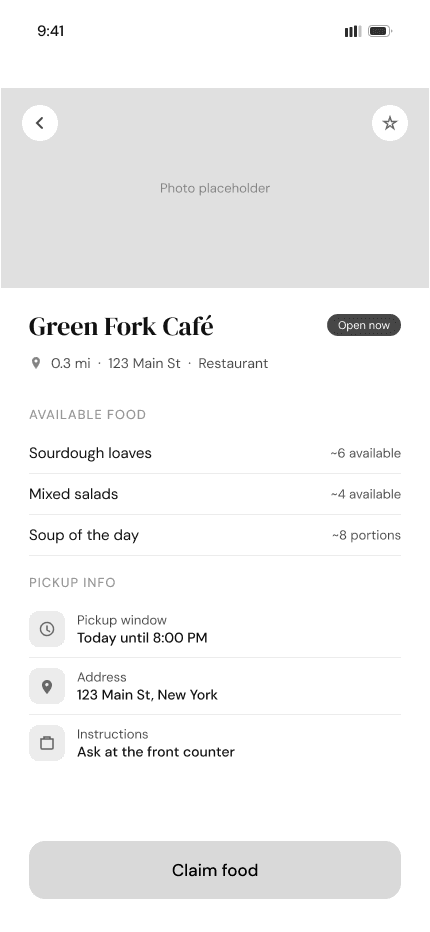
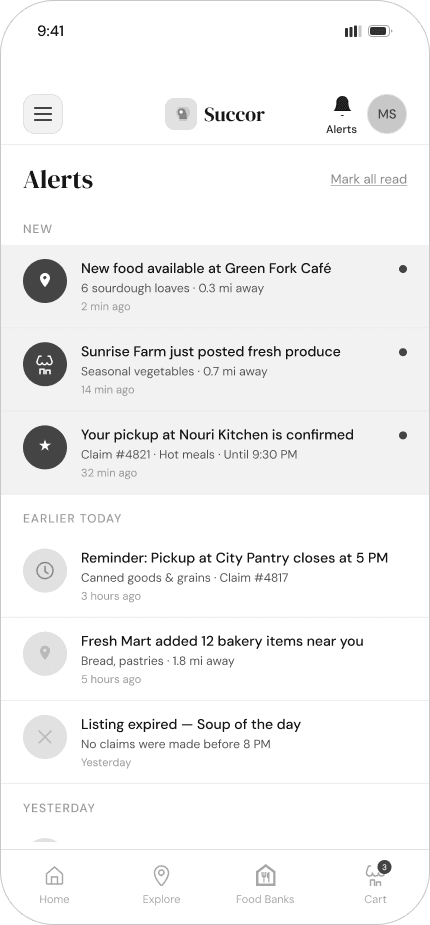
Digital wireframes
Paper concepts translated into digital wireframes for mobile. Focused on reducing steps to claim food, clear food information display, and discreet pickup flow.